Leading Yourself
Your State Is Your Strategy: The Four Operating Modes of Every Leader
Skill doesn't decide your day. Your operating mode does. The four modes every leader moves between, how to tell which one you're in, and why the climb from survival to mastery is trainable.
· Leading Yourself · 9 min read
Here is an uncomfortable idea: the quality of your leadership this week will not be set by your competencies. You already know how to plan, delegate, and run a meeting. It will be set by something that changes hour by hour and that almost nobody tracks — the mode you are operating in.
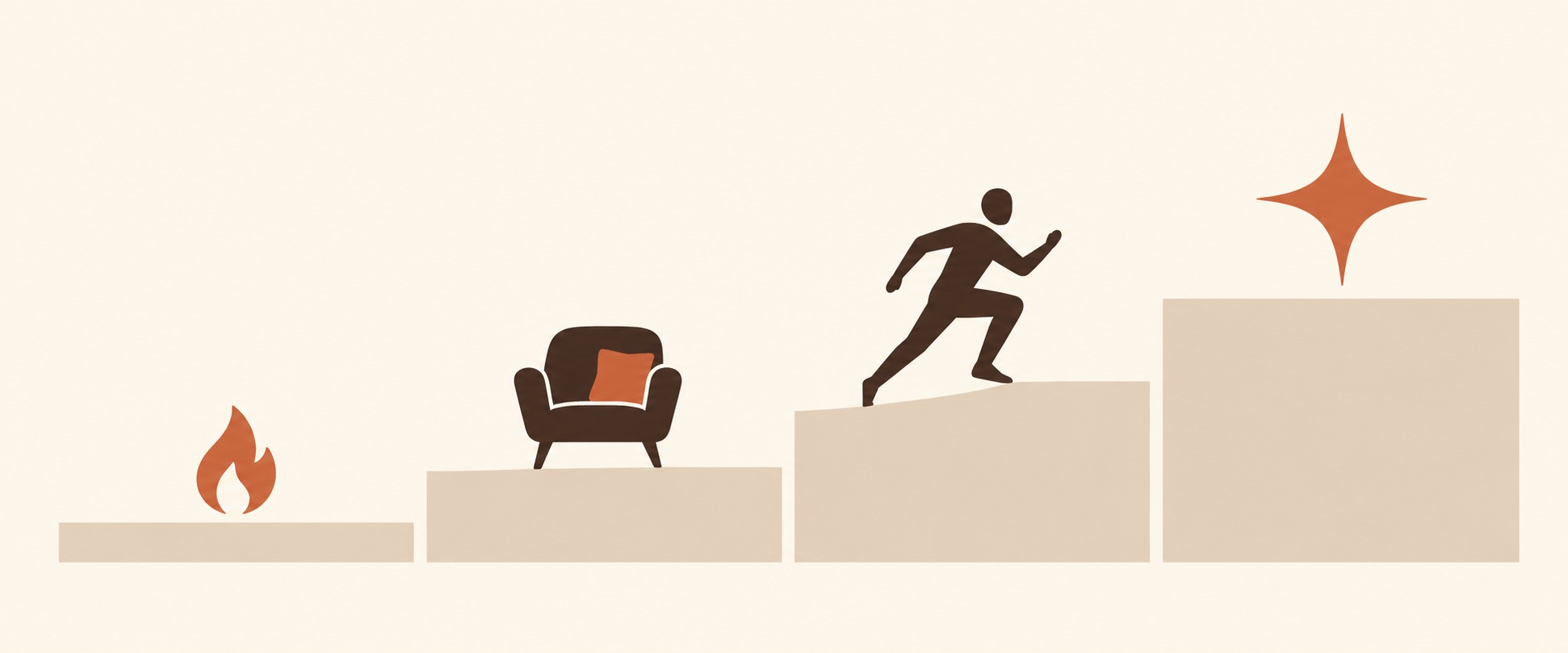
I want to give that something a name, because unnamed things can’t be managed. Every person — every leader, every player on your team — runs in one of four operating modes. Not personality types. Modes. States you move between, sometimes several times a day, sometimes stuck in one for years.
The four modes
Survival mode. Threat is running the show. The horizon shrinks to the next problem. Time feels scarce, people feel like obstacles, and every conversation is a defense. Nobody in survival mode is strategic — not because they lack the intelligence, but because threat crowds out the horizon. The tell is not stress. Everyone has stress. The tell is shrinkage: shorter planning windows, shorter sentences, shorter patience.
Comfort mode. Nothing is on fire, and that is exactly the problem. The work is stable, the feedback loops are quiet, the risks are managed. Comfort mode feels like competence from the inside — you’re experienced, reliable, things run — and like slow-motion decline from the outside. It is the most expensive mode on this list because it doesn’t hurt. Leaders can live in comfort mode for a decade and call it a career.
Performance mode. You are engaged, connected, and producing. Attention is wide, communication is two-way, problems are solvable and getting solved. This is where good weeks happen. It is not heroic — it is the normal, healthy state of a capable person with enough energy and no unresolved threat in the room.
Mastery mode. The rare one. Effortless, generous, at cause. In mastery mode you produce your best work and it costs less than usual, and the people around you get better just by being in the game with you. It visits; it doesn’t need to live there full-time to change your career.
Why this matters more than your calendar
Most leadership development trains the map: frameworks, feedback models, one-on-one structures. All useful. But the map isn’t the territory — the territory is the mode you’re in when you use it. Run the best one-on-one framework of your life in survival mode and it comes out sideways: clipped, transactional, silently adversarial. Run an average framework in performance mode and it lands fine.
That’s the reframe: your state is your strategy. Two leaders with identical playbooks get opposite results because the playbook is executed by the state, not the other way around.
And here’s the part that makes it actionable: modes are not random, and they are not character. They follow energy and unresolved events, which means they can be read, and reading them is a skill.
How to read your mode (and everyone else’s)
You can’t manage what you only notice in hindsight. The way out is a set of early-warning signs — observable behaviors, not feelings. Feelings lie; behavior doesn’t. Check these four channels:
- Vocabulary. Survival narrows words: “I have to,” “they made me,” “no option.” Performance widens them: “I choose,” “next,” “here’s what I want.” Listen to your own first sentence in any meeting — it announces your mode.
- Horizon. How far ahead are you actually planning, right now, honestly? Days = survival. Quarters with no stretch = comfort. A future you’re actively building = performance or above.
- Listening. In survival mode you reload while others talk. In comfort mode you wait for your turn. In performance mode you actually track what they said — and can repeat it back accurately.
- Posture of credit and blame. Survival blames. Comfort shrugs. Performance owns specifics: “I got that wrong” without self-flagellation, “that was us” without politics.
Run this scan on yourself before your next hard meeting. Then run it on the room. You’ll find you can locate every person on your team in a mode within five minutes of paying attention — and that this is more operationally useful than any competency matrix you’ve been handed.
The climb
The modes stack. You can’t jump from survival to mastery; anyone selling that jump is selling adrenaline, not training. You climb one mode at a time, and each climb has its own work:
- Survival → Performance is not about positivity. It’s about resolving — naming the threat, cutting it down to its actual size, and taking one action that ends the wait. Most survival loops persist because the trigger was never looked at directly.
- Comfort → Performance is about choosing a bigger game deliberately. Comfort mode doesn’t break on its own; something has to be put at stake, by you, on purpose.
- Performance → Mastery is the long game — the compounding of unlearning, vocabulary, and practice that we’ll cover across this pillar.
The essays that follow take each rung seriously: the exit from survival, the trap of comfort, your early-warning system, the four kinds of players you’ll meet on teams, and the emotional debt that keeps pulling capable people back down.
This week's practice
Once a day — same time, every day — stop and score yourself on one question: which mode am I in right now? Don't fix anything. Don't judge it. Write the mode and one piece of evidence (a sentence you said, a plan you made, how you listened in your last meeting).
Seven entries. At the end of the week, look for the pattern: which mode dominates, at what hours, after what events. That pattern — not any personality test — is your actual leadership baseline, and the thing your next strategy should be built around.